When a Filling Is Not Quite Enough: Understanding Inlays and Onlays
Sometimes a tooth needs more support than a filling can provide, but not enough treatment to require a full dental crown. That middle ground is where inlays and onlays can be especially useful. These custom restorations allow us to repair damaged or decayed areas while preserving healthy portions of your natural tooth.
If you have never heard of an inlay or onlay before, the names may sound a little technical, but the idea behind them is actually quite simple. They give us another way to restore a tooth based on what that particular tooth needs.
When Might You Need More Than a Filling?
Fillings work very well when tooth decay or damage affects a relatively small area, but when a larger portion of the biting surface has been weakened, placing another filling may not provide enough support. At the same time, there may still be plenty of healthy natural tooth structure remaining. Rather than covering the entire tooth with a crown, an inlay or onlay can restore only the damaged area. This makes them a useful option when we want to strengthen the tooth while keeping as much healthy structure as possible.
What Is the Difference Between an Inlay and an Onlay?
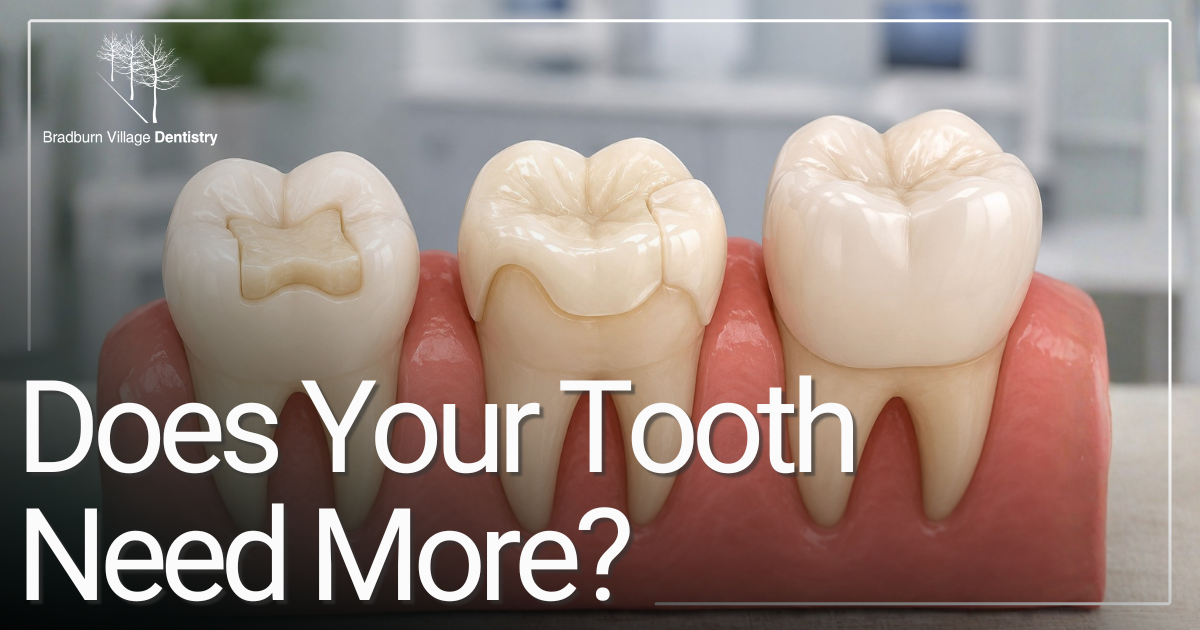
The difference comes down to how much of the tooth needs to be restored. An inlay fits within the raised edges, or cusps, on the chewing surface of the tooth. You can think of it as a custom restoration that fits precisely into the damaged area.
An onlay covers a larger portion of the tooth and extends over one or more of those cusps. It provides additional coverage when more of the biting surface needs support. Which one is appropriate depends on the location and extent of the damage. Two teeth with similar-looking problems may still need different restorations once we take a closer look.
Designed for Your Tooth
Unlike a filling that is placed directly into the tooth during the appointment, an inlay or onlay is custom made to fit. They may be created from materials such as porcelain, composite resin, or gold. Porcelain is often appealing because it combines strength with a color that can blend naturally with your surrounding teeth. The goal is to create a restoration that fits the damaged area closely and allows the tooth to function comfortably again.
What Happens During Treatment?
Inlay and onlay treatment typically takes two appointments. During the first appointment, we remove the damaged, decayed, or existing filling material and prepare the tooth. We then take an impression so your custom restoration can be created to fit your tooth and bite. A temporary sealant protects the area while the permanent inlay or onlay is being made.
At your second appointment, we remove the temporary material and carefully check the fit of your new restoration. Your bite matters here too. We want to make sure the restored tooth feels comfortable when your upper and lower teeth come together.
Once everything looks and feels right, the inlay or onlay is securely bonded to the tooth and polished to a smooth finish.
Why Preserving Healthy Tooth Structure Matters
When a tooth is damaged, the answer is not always to remove more of it. Whenever possible, preserving healthy natural tooth structure gives us an opportunity to restore what needs attention without unnecessarily changing the rest of the tooth. That is one of the reasons inlays and onlays can be such a helpful treatment option. They fall between a filling and a crown, giving us more flexibility when deciding how much support a tooth actually needs.
Every Tooth Is Different
There is no single restoration that is right for every damaged tooth. A smaller area may be best treated with a filling. A larger area may benefit from an inlay or onlay. If the tooth has been significantly weakened, a crown may offer the protection it needs. The decision depends on how much healthy structure remains, where the damage is located, how the tooth functions when you bite, and what will give it reliable support moving forward.
If you have a chipped, damaged, or heavily filled tooth, schedule an appointment with our office located in Westminster, CO. We can take a closer look at what is happening and help you understand whether a filling, inlay, onlay, crown, or another option makes the most sense for your smile.