Why Does the Position of Your Tongue Matter?
Here is a question you probably have not been asked at the dentist before: Where is your tongue right now? When your mouth is relaxed, you may not think about your tongue, but it is still doing something. Where it rests, how it moves, and how it works with your lips, jaw, and other muscles are all parts of normal oral function. At Bradburn Village Dentistry, we look beyond teeth and gums because functions such as breathing and swallowing can provide useful information about the bigger picture of oral health.
What Is Tongue Posture?
Tongue posture simply refers to where your tongue rests when you are not eating, drinking, or speaking. Ideally, the tongue rests gently against the roof of the mouth, with the tip positioned just behind the upper front teeth rather than pushing against them.
This resting position may seem like a tiny detail. But consider how much time your tongue spends at rest throughout the day and night. A pattern repeated for hours every day can matter, particularly while a child’s mouth and face are developing.
Your Tongue Has a Lot of Jobs
The tongue is remarkably busy. It helps you chew food, move it through your mouth, swallow, and form sounds when you speak. The tongue also works together with your lips, cheeks, jaw, and other muscles during these activities.
When those muscles develop patterns that don’t function as intended, we may see clues in how someone swallows, speaks, breathes, or holds their mouth at rest. That is one reason we are interested in function, not simply the appearance of the teeth.
What Does Breathing Have to Do with It?
Tongue posture and breathing can be closely related. When you breathe comfortably through your nose, your lips can remain closed, and your tongue can rest against the roof of your mouth. Someone who frequently breathes through the mouth may develop a different resting pattern, with the lips apart and the tongue positioned lower in the mouth. Many factors can cause mouth breathing, so noticing the pattern does not tell us the cause. Instead, it may encourage us to look more closely at breathing and oral function.
Why Tongue Position Can Be Especially Important for Children
Childhood is a period of tremendous growth and development. The tongue, lips, cheeks, and other oral muscles interact with developing teeth and jaws every day. This makes patterns involving breathing, swallowing, and tongue posture especially important when evaluating a growing child. Parents may notice open-mouth posture, frequent mouth breathing, unusual swallowing patterns, speech concerns, or other behaviors that raise questions.
Adults Have Oral Muscle Patterns Too
Tongue posture is not only something we consider in children. Adults can also develop or continue patterns involving the tongue, lips, jaw, swallowing, and breathing. In some cases, these patterns may matter when someone has concerns about oral function. The first step is understanding what is happening and whether something needs to be addressed.
What Is Myofunctional Therapy?
When certain oral muscle patterns need attention, myofunctional therapy may be appropriate. Myofunctional therapy uses specific exercises and techniques to help retrain patterns involving the tongue and other oral muscles. Depending on the individual, therapy may focus on tongue posture, swallowing, lip function, or other functional habits. It is not a one-size-fits-all program. We base the exercises and goals on what we identify during an individual evaluation.
And What About Tongue-Ties?
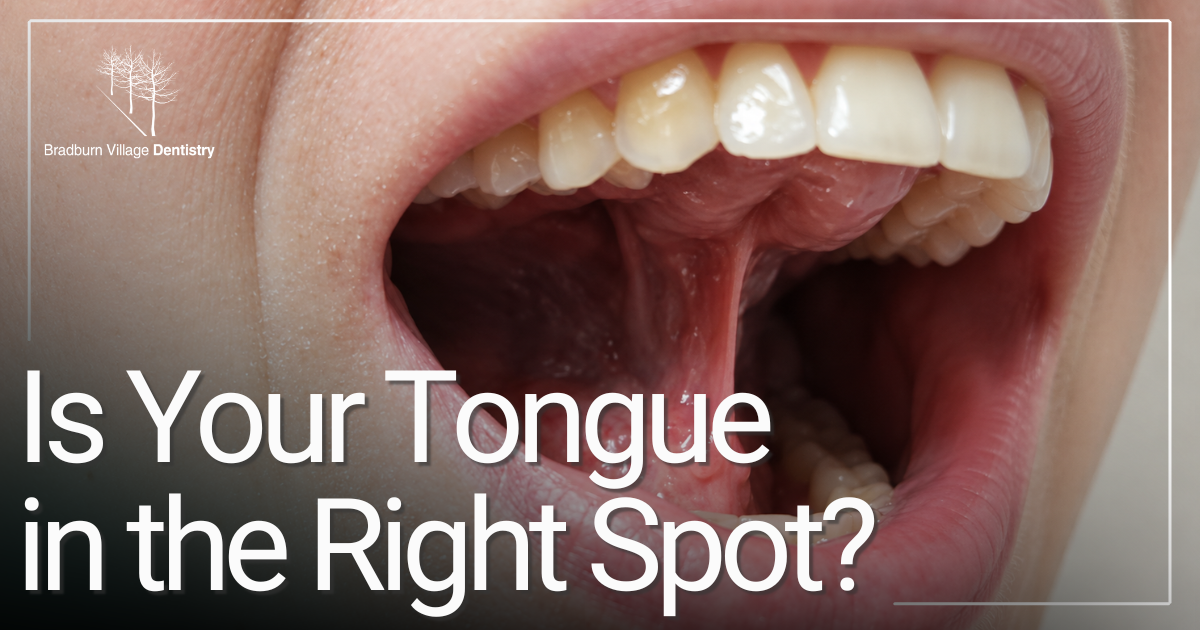
A tongue-tie can restrict the tongue’s range of motion, which is one reason we evaluate tongue function when a tongue-tie is present. However, not everyone with an unusual tongue posture has a tongue-tie, and simply releasing restricted tissue does not automatically retrain an established muscle pattern. When a frenectomy is appropriate, understanding function before and after the procedure can be an important part of the overall approach.
Look Beyond the Teeth
Your tongue may be easy to overlook, but it plays an important role in some of the things you do all day without thinking about them. Breathing, swallowing, speaking, eating, and even resting. At Bradburn Village Dentistry, our whole-body approach encourages us to look at how these pieces work together rather than focusing only on individual teeth.
If you have questions about tongue posture, mouth breathing, swallowing, or other oral function concerns for yourself or your child, schedule an appointment with Bradburn Village Dentistry located in Westminster, CO. We can evaluate what is happening and help you understand whether myofunctional therapy or additional care may be appropriate.